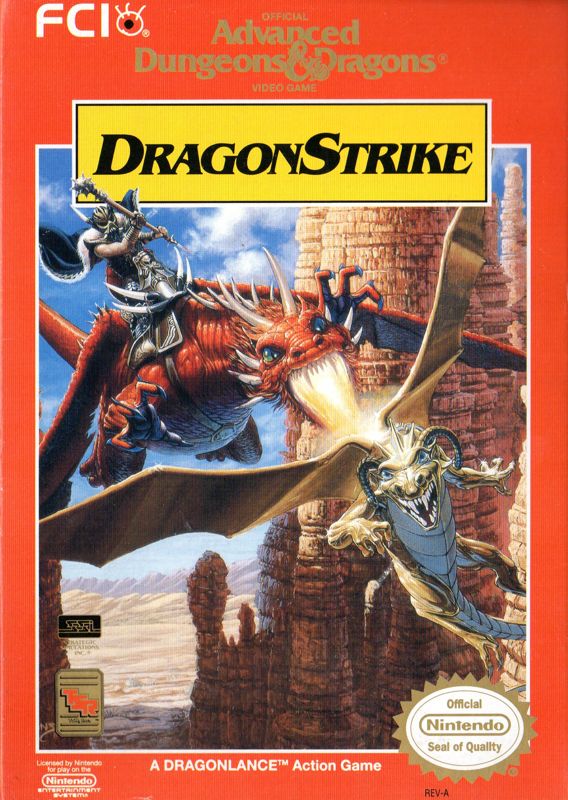
DragonStrike – The Forgotten Dragon Combat Classic of the NES Era
During the early 1990s, the Nintendo Entertainment System was nearing the end of its legendary run. The Super Nintendo had already arrived, Sega Genesis was exploding in popularity, and gamers were beginning to expect bigger graphics and more advanced gameplay experiences. Yet even during those final NES years, a handful of unusual titles managed to stand out from the crowd. One of the strangest and most ambitious was Advanced Dungeons & Dragons: DragonStrike.
Released in 1992 by Westwood Associates and published by Pony Canyon and FCI, DragonStrike was unlike almost anything else on the NES. While most fantasy games focused on swords, castles, or side-scrolling action, DragonStrike placed players directly into aerial dragon combat. Instead of controlling a warrior on foot, players took control of a dragon soaring through the skies of the Dragonlance universe.
The result was one of the most unusual and underrated action games on the NES — a title that mixed fantasy storytelling, shooting mechanics, and dragon combat into something that felt far more ambitious than most 8-bit games of its era.
A Dungeons & Dragons Adventure in the Sky
DragonStrike was based on the famous Advanced Dungeons & Dragons universe, specifically the Dragonlance setting. The original DragonStrike released for computers in 1990 as a fantasy flight simulator where players rode dragons into massive aerial battles during the War of the Lance.
The NES version, however, was completely redesigned. Instead of first-person dragon combat, the NES game became a top-down action shooter. While that may sound disappointing to fans of the computer original, the developers wisely realized that the NES hardware simply could not recreate the complex 3D gameplay of the PC release. Rather than attempting a weak port, they built a totally different game around the same world and themes.
The end result actually worked surprisingly well.
Players controlled a dragon flying across forests, mountains, rivers, castles, and enemy fortresses while battling endless waves of enemies. Missions included destroying enemy armies, surviving ambushes, and defeating powerful bosses. The game constantly moved forward, giving the experience the feeling of an intense fantasy war taking place high above the battlefield.
For NES players accustomed to traditional side-scrolling platformers, DragonStrike immediately felt different. There were no plumbers, ninjas, or cartoon mascots here. Instead, the game delivered dragons, magic, and large-scale aerial warfare.
The Atmosphere Was Surprisingly Dark
One thing that separated DragonStrike from many NES games was its tone. The game embraced the darker fantasy atmosphere of the Dragonlance universe rather than presenting a lighthearted adventure.
The environments often looked bleak and dangerous. Enemy dragons swooped across the screen while armies attacked from below. Castles burned, monsters emerged from nowhere, and giant bosses filled the skies with deadly projectiles.
The soundtrack added to the mood tremendously. The music carried a dramatic fantasy style that made each stage feel important and dangerous. While the NES sound chip had obvious limitations, the composers still managed to create memorable battle themes that gave the game a sense of epic adventure.
This darker atmosphere made DragonStrike feel more mature than many other NES games released around the same time.
Dragon Combat Was the Main Attraction
DragonStrike lived and died by its dragon combat mechanics, and thankfully they were surprisingly fun once players learned them.
Flying through levels felt fast and energetic. Players could unleash fire breath attacks while dodging enemy projectiles and avoiding obstacles. Some enemies attacked directly from the air, while others fired upward from the ground below.
The controls initially felt unusual because dragon movement had a heavier feel compared to the precise platforming controls common in NES games. But once players adapted, the combat became highly satisfying.
One of the coolest parts of the game was simply the fantasy of controlling a dragon. During the early 1990s, very few games allowed players to experience aerial dragon combat. DragonStrike delivered something that genuinely felt fresh and unique.
The game also did an excellent job making players feel powerful. Blasting enemy creatures with dragon fire while soaring across huge battlefields created moments that felt epic by NES standards.
The Difficulty Could Be Ruthless
Like many games from the NES era, DragonStrike was not easy. In fact, some players considered it brutally difficult.
Enemy attacks could overwhelm players quickly, especially during later missions. Boss battles often filled the screen with projectiles, forcing players to memorize attack patterns while carefully managing movement.
The game also demanded constant attention because danger could come from every direction. Unlike slower RPG-style fantasy games, DragonStrike required quick reflexes and rapid decision-making.
Some levels became especially punishing because of limited health recovery and relentless enemy waves. Younger players renting the game during the 1990s likely struggled to reach the ending without significant practice.
Yet this difficulty also became part of the game’s appeal. Many retro gamers remember DragonStrike as one of those titles that felt rewarding precisely because it demanded patience and skill.
A Technical Achievement on the NES
Looking back today, DragonStrike remains impressive simply because of how much it attempted on aging NES hardware.
The game featured relatively large environments, numerous enemies on screen, and fast-moving action without completely collapsing under slowdown. That was not an easy accomplishment for an 8-bit console released in the mid-1980s.
The dragon sprites themselves looked detailed for the hardware limitations, and the game often created the illusion of large-scale aerial warfare despite the NES’s modest capabilities.
Westwood Associates, the developers behind the game, would later become famous for legendary PC titles like Command & Conquer and Blade Runner. Even in DragonStrike, players could already see the studio’s ambition and creativity beginning to emerge.
While the game certainly could not compete visually with 16-bit titles appearing at the same time, DragonStrike still pushed the NES harder than many developers bothered to during the console’s final years.
Why DragonStrike Was Forgotten
Despite its creativity, DragonStrike never became a major hit. Several factors contributed to the game fading into obscurity.
First, the NES was already losing popularity by 1992. Many gamers had moved on to the SNES or Genesis, meaning late NES releases often received less attention.
Second, DragonStrike was difficult to categorize. It was not quite a traditional shooter, not quite an RPG, and not quite a flight simulator. That uniqueness helped the game stand out, but it also made marketing more difficult.
Third, Dungeons & Dragons games during the early console era were often inconsistent in quality. Some players may have ignored DragonStrike simply because licensed fantasy games had a mixed reputation.
As time passed, bigger franchises overshadowed it. Games like Final Fantasy, Zelda, and Castlevania dominated retro gaming discussions while DragonStrike quietly disappeared into bargain bins and forgotten rental shelves.
Yet among retro collectors and NES enthusiasts, the game slowly developed a cult following.
The Game’s Cult Legacy
Today, DragonStrike is remembered as one of the NES library’s hidden gems. Retro gamers who revisit it are often surprised by how ambitious and atmospheric it feels compared to many better-known titles.
Collectors especially value the game because it represents such a strange combination of genres and ideas. It is not every day that players encounter an 8-bit fantasy dragon combat shooter based on Dungeons & Dragons lore.
Modern players also appreciate how different the game feels from modern fantasy titles. Today’s fantasy games often focus on enormous open worlds and cinematic storytelling. DragonStrike instead delivers a pure arcade-style combat experience with relentless pacing and straightforward action.
The game has also gained appreciation because of its connection to Westwood Studios. Looking back, DragonStrike now feels like an early glimpse at the creativity that would later make the company famous.
Many retro fans now consider it one of the more interesting overlooked games in the entire NES library.
A Dragon Worth Rediscovering
Advanced Dungeons & Dragons: DragonStrike may never achieve the same legendary reputation as Mega Man, Metroid, or Zelda, but it absolutely deserves more recognition than it usually receives.
The game delivered something genuinely original during a time when many developers were simply recycling existing formulas. It combined fantasy atmosphere, dragon combat, fast-paced action, and challenging gameplay into an experience unlike almost anything else on the NES.
Yes, the difficulty could become frustrating. Yes, the controls required patience. But beneath those challenges was a bold and creative game that tried to push the NES beyond its normal limits.
For retro gamers willing to revisit forgotten classics, DragonStrike remains a fascinating piece of 8-bit history — a strange, ambitious, and highly memorable fantasy adventure that proved dragons could be just as exciting as spaceships.
Pictures